how to
renew
your Medicaid coverage

Here’s a step-by-step guide to renewing your coverage.
Remember, we’re here to help. Call us with questions: 866-606-3700 (TTY: 711).
Renewing your Medicaid is how you can keep your healthcare coverage for another year.
Every year, everyone with Medicaid coverage needs to go through a renewal process. Everybody’s renewal date is different, so it’s important that you get ready to renew now.
Here’s what you need to do:

Log in to HFS Manage My Case.
Go to abe.illinois.gov and log in to your Manage My Case account. If you don’t have an account, you can create one.
Did you know? You can manage all of your benefits online through HFS Manage My Case. Learn more about everything you can do with Manage My Case.
These links will take you to websites run by the Illinois Department of Healthcare and Family Services (HFS).

Verify your address.
If you have Medicaid coverage, it is important to keep your address up to date. This is because important documents, like your renewal form, come in the mail.
To verify your address in HFS Manage My Case, go to abe.illinois.gov and log in to your account.
In the portal, click “Contact Us.” Then check or update your household information.
You can also verify your address over the phone. Call 1-800-843-6154 (TTY: 1-866-324-5553), Monday through Friday, 8:00 a.m. to 5:00 p.m.
These links will take you to websites run by the Illinois Department of Healthcare and Family Services (HFS).

Find your due date.
You need to renew your Medicaid coverage once per year. You can find your next due date, also called a redetermination date, through HFS Manage My Case. First, log in or create an account. Then, click on the “Benefit Details” tab to see when your renewal date is.
Want reminders when it’s time to renew? Click on the “Account Management” tab in Manage My Case. Under “Manage your communications preferences,” opt in for text and email alerts.
These links will take you to websites run by the Illinois Department of Healthcare and Family Services (HFS).

Watch your mail.
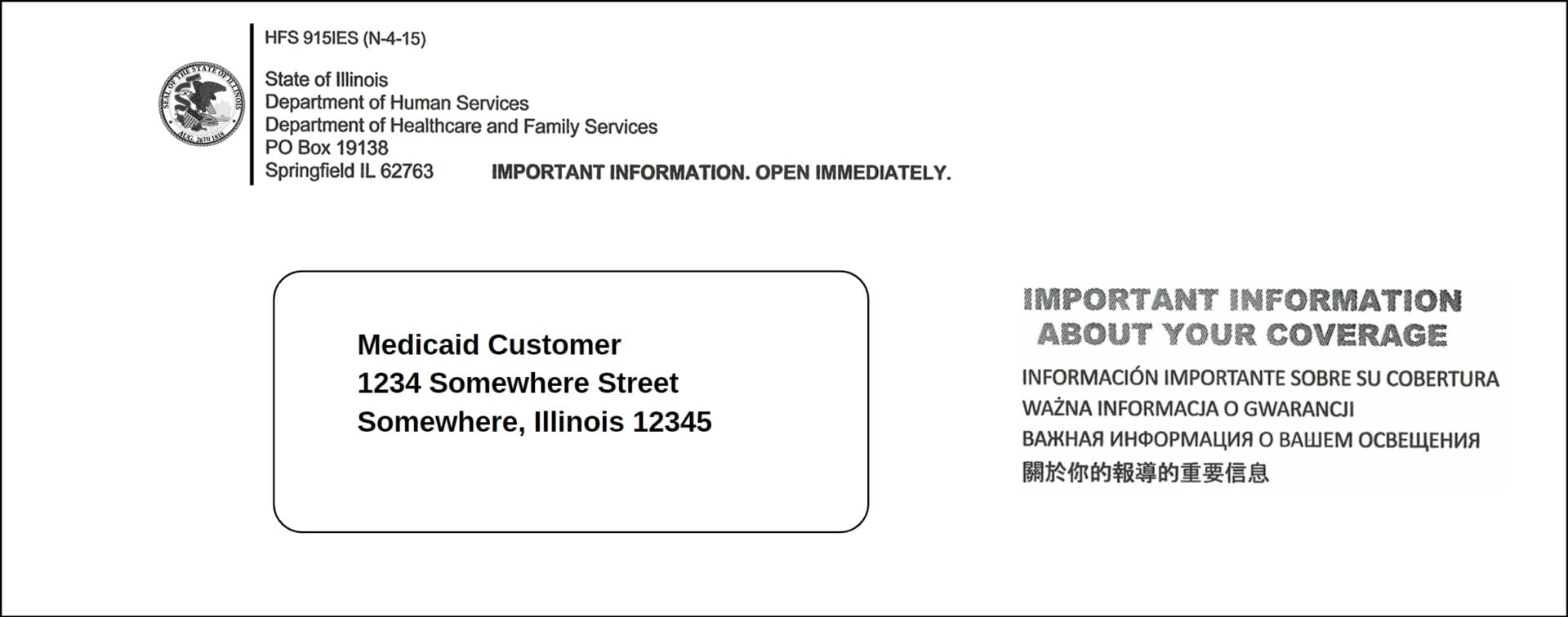
You will get your renewal materials in the mail about one month before your due date. The envelope will look like this.
Your materials will include an official letter about your Medicaid status. It will tell you if you need to complete a form to renew your benefits.

Complete your renewal.
Your letter may say you need to complete a renewal form in order to keep your coverage. Be sure to fill out and turn in your form before your due date (redetermination date) to avoid losing your Medicaid benefits.
Your form will ask you to provide information about your family and finances. Learn more about the information and documents you may need to fill out your form.
You can choose how to complete and submit your renewal form:

Renew online
You can fill out your renewal form online through your Manage My Case portal.
Log in or create an account

Renew by mail
Fill out the form you got with your letter and use the prepaid envelope to mail it back.

Renew over the phone
You can provide all of your renewal information over the phone. Call HFS toll-free at 1-800-843-6154 (TTY: 1-866-324-5553), Monday–Friday, 8:00 a.m. to 5:00 p.m.
These links will take you to websites run by the Illinois Department of Healthcare and Family Services (HFS).
We’re here to guide you through the renewal process.
Use this interactive tool to learn what to do next.

What happens next
After you submit your renewal form, the state’s Medicaid office at HFS will let you know if you’re still eligible for Medicaid. If you are, you don’t have to do anything else—you’re covered!
If you are no longer eligible for Medicaid, don’t worry. You may be able to connect to coverage at work or through the official Affordable Care Act Marketplace for Illinois, GetCoveredIllinois.gov.
Questions you may have
Medicaid is a public health insurance program that is jointly administered by the federal and state governments. It helps people with limited income to get affordable healthcare services, including provider visits, hospital care, vision, dental, and prescription coverage.
Medicaid covers a wide range of people, including:
- Children
- Pregnant women
- Working adults
- Individuals with limited incomes
- Older adults, including those who are also eligible for Medicare (dual eligible)
- People with disabilities
Approximately 1 in 5 people in the U.S. are covered by Medicaid, including more than 3 million people in Illinois.
Medicaid in Illinois is run by the Illinois Department of Healthcare and Family Services (HFS). It is also called HealthChoice Illinois. Meridian Medicaid Plan helps provide your Medicaid coverage.
The federal government has made significant changes to Medicaid eligibility:
- Starting January 1, 2027, adults who get health insurance through the Affordable Care Act, also referred to as ACA adults, will need to take new steps to keep their healthcare benefits:
- Prove they meet the new work, education, or community service requirements OR qualify for an exemption based on a circumstance or condition.
- Renew their Medicaid coverage twice a year (every six months) instead of once a year (every 12 months).
- Starting in October 2026, only Qualified Immigrants will be eligible for Medicaid. Currently, some non-citizens can still access Medicaid as “qualified immigrants.” Starting October 2026, the definition of qualified immigrants will change to exclude refugees, people seeking asylum (Temporary Protected Status), and victims of domestic violence and trafficking (Violence Against Women Act applicants and T visa holders. These immigrant groups will still be eligible for Medicaid:
- People with legal permission to live in the U.S. (green card holders) after they have lived here for five years
- Cuban and Haitian immigrants
- Compact of Free Association migrants and citizens of the Freely Associated States (like Micronesia, Marshall Islands, and Palau) who have legal permission to live in the U.S.
- Pregnant women and children under age 18 who are not U.S. citizens
All states are implementing these changes.
Starting January 1, 2027, some adult Medicaid customers may need to report work, education, or community service hours to continue receiving coverage. They will also need to renew their Medicaid coverage twice a year (every six months), instead of once a year (every 12 months).
Generally, the new federal requirements will apply to individuals in the ACA expansion population who are:
- Ages 19 to 64
- Not receiving Medicare
- Do not have a dependent child 18 years old or younger in their home
ACA adults will need to prove they meet the new work, education, or community service requirements. Or they will need to apply for an exemption based on a circumstance or condition to continue receiving coverage.
The following ACA adults will be eligible for exemptions from work requirements:
- People with a serious and complex health condition, mental health condition, or substance use disorder
- People receiving SSI (Supplemental Security Income) and SSDI (Social Security Disability Insurance)
- Caretakers for an individual with a disability
- People subject to SNAP work requirements or meeting TANF work requirements
- Veterans with total disability ratings
- People recently released from public institutions, like jail or prison
The new requirements will not apply to:
- Children under age 19
- Adults age 65 and older
- Parents or guardians with a dependent child age 18 or younger living with them (these individuals are generally in the Family Health Plan category of Medicaid and are not ACA Adults)
- Women who are pregnant or who have given birth within the last 12 months
- Foster youth or former youth in care under age 26
People who must meet work requirements can do so in several ways:
- Employment: A minimum of 80 hours of work per month or a monthly pre-tax (gross) income of at least $580 per month (different rules for seasonal workers)
- Enrollment in an educational program: At least half-time enrollment in higher education or a career or technical education program
- Work program participation: Participation in a work program for a minimum of 80 hours per month
- Community service: A minimum of 80 hours of community service per month
More details about how a person can submit information about their hours will be shared by HFS this fall.
Currently, some non-citizens can enroll in Medicaid as “qualified immigrants.” The federal definition of “qualified immigrant” will change, limiting eligibility for Medicaid, starting in October 2026.
Non-citizens/immigrants who will no longer be eligible for Medicaid include:
- Refugees who are legally living in the U.S.
- People seeking asylum (Temporary Protected Status)
- Victims of domestic violence and trafficking (Violence Against Women Act applicants and T visa holders)
Non-citizens/immigrants who will still be eligible for Medicaid include:
- Women who are pregnant
- Children under age 19
- People with legal permission to live in the U.S. (green card holders) after they have lived here for five years
- Cuban and Haitian immigrants
- Compact of Free Association migrants and citizens of the Freely Associated States (like Micronesia, Marshall Islands, and Palau) who have legal permission to live in the U.S.
All Medicaid enrollees should make sure their contact information is up to date with HFS and their primary care provider.
To learn how to update your contact information with HFS, visit https://ilhfspartner3.dynamics365portals.us/addressupdate, log-in to abe.illinois.gov, or call 1-877-805-5312.
HFS will inform enrollees of any changes to their eligibility or new requirements to keep their coverage.
The federal government is expected to give states instruction on how to implement these changes soon.
Details on steps that ACA adult enrollees may need to take to keep their Medicaid coverage will be shared in September 2026.
Redetermination is a review of an enrollee’s eligibility for Medicaid. It is how HFS determines if someone is still eligible for coverage.
Enrollees will receive paperwork in the mail when it is time to complete redetermination. That’s why it is so important for HFS to have an enrollee’s current mailing address on file.
The redetermination paperwork must be completed and mailed back to HFS or the enrollee could lose their Medicaid coverage.
Redetermination can also be completed online by going to ABE Manage My Case at abe.illinois.gov.
Beware of scams. Illinois will never ask you for money to renew or apply for Medicaid. Report scams to the fraud report website or the Medicaid fraud hotline at 1-844-453-7283/1-844-ILFRAUD.
The Illinois Application for Benefits Eligibility (ABE) Manage My Case portal allows users to manage their Medicaid enrollment, update their contact information, and more.
All users of the ABE portal are required to create an ILogin account with the State of Illinois and an ABE profile. To register, the user must have an email address.
To create an ILogin Account, visit: iloginhelp.illinois.gov
To access the ABE portal or create an ABE profile, visit: abe.illinois.gov
On the ABE Manage My Case portal, enrollees can:
- Apply for benefits or renew benefits
- Update their contact or household information
- Sign up for electronic or text notification
- File and manage appeals
- Review notices about their case
For technical support with the ABE portal, visit dhs.state.il.us/page.aspx?item=98456 or call the ABE customer call center at 800-843-6154.
Medicaid eligibility is based on several financial and non-financial factors like household income, family size, Illinois residency, and immigration status. In Illinois, most people with income up to 138% of the federal poverty level (FPL) are eligible to receive benefits.
Household size: 1
138% of FPL (monthly): $1,835.42
138% of FPL (annually): $22,025
Household size: 2
138% of FPL (monthly): $2,448.58
138% of FPL (annually): $29,863
Household size: 3
138% of FPL (monthly): $3,141.83
138% of FPL (annually): $37,702
Children and pregnant individuals qualify for Medicaid at higher household income levels. Some adults qualify at lower income levels and need to meet asset tests.
Eligibility is determined by HFS. More information is available on the HFS website.
Yes, people can still apply for Medicaid health coverage or renew their existing health coverage if they are still eligible. For more information about applying for Medicaid, visit the HFS website, log-in to abe.illinois.gov, or call 1-800-843-6154.
If someone loses Medicaid coverage, they can buy health insurance through Get Covered Illinois. Most people who enroll in health coverage through Get Covered Illinois qualify for financial help.
Losing Medicaid coverage does not prevent an enrollee from applying again. An individual might reapply after a change in life circumstances, such as a change in income, becoming pregnant, or developing a health condition.
For more information about applying for Medicaid:
- Visit the HFS website
- Log-in to abe.illinois.gov
- Call 1-800-843-6154
Questions? Contact us.
Call us with your Medicaid renewal questions.
Meridian Member Services
866-606-3700 (TTY: 711)
Monday–Friday
8:00 a.m. to 5:00 p.m.